Hydraulic manifold blocks are compact, high-function parts that route pressurized fluid between pumps, valves, cylinders, motors, and gauges. By integrating passages and ports into one machined block, equipment builders can reduce external hoses and fittings, simplify assembly, and minimize potential leak points.
For industrial equipment, a manifold is more than a drilled metal block. Port positions, thread forms, sealing faces, internal intersections, and cleanliness all influence whether the finished hydraulic system performs reliably. CNC machining gives engineers the precision and design flexibility needed for prototypes, replacement parts, and repeat production.
What Is a Hydraulic Manifold Block?
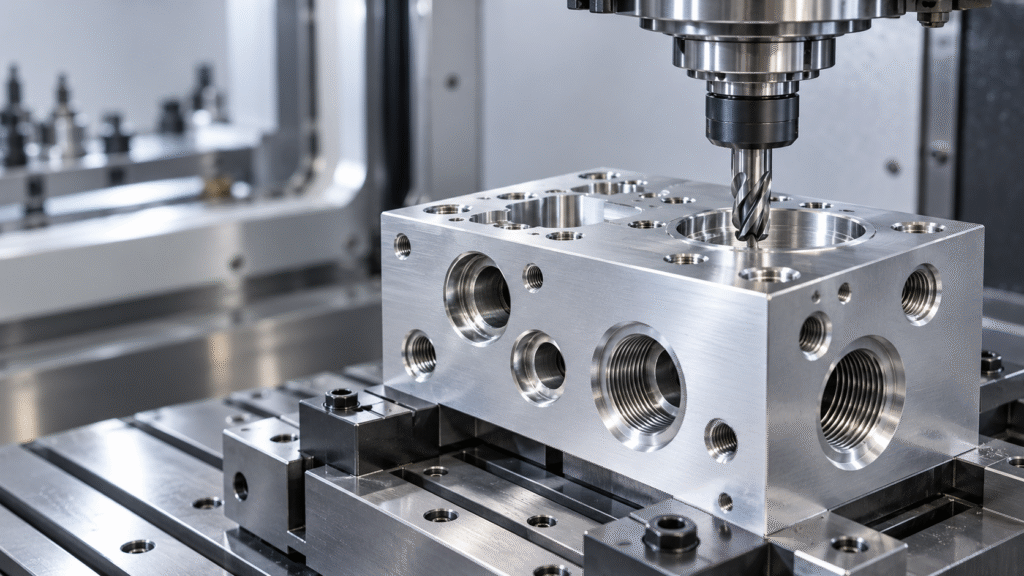
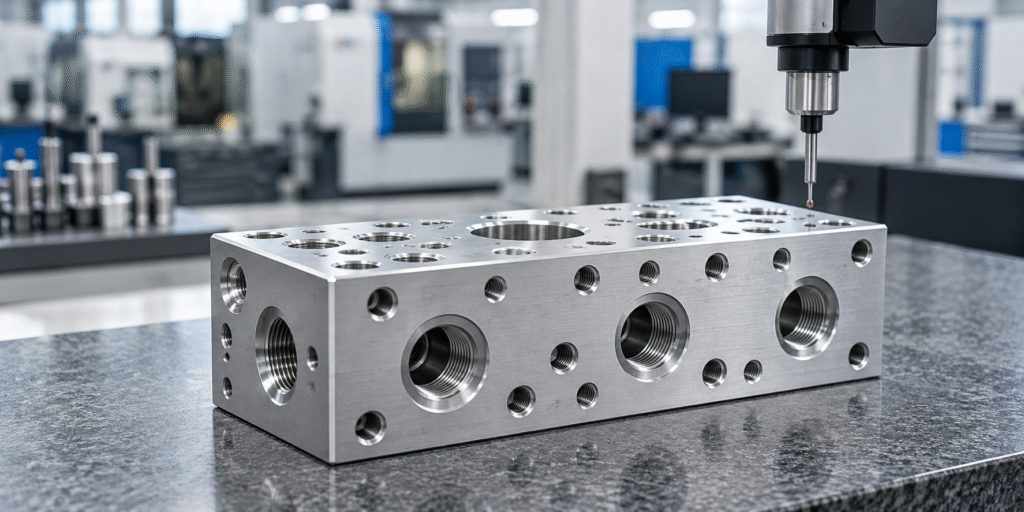
A hydraulic manifold is normally machined from aluminum, carbon steel, alloy steel, stainless steel, or another specified material. It contains drilled, milled, bored, and threaded features that direct fluid to the intended circuit. Typical features include inlet and outlet ports, cartridge-valve cavities, gauge ports, cross-drilled passages, O-ring sealing faces, mounting holes, counterbores, and threaded plugs.
Much of the functional geometry is internal. That makes accurate 3D CAD data, a complete drawing, and clear port specifications essential before production begins.
Why CNC Machining Matters
Accurate Port Location
Valve, fitting, and gauge ports must align with mating components. CNC milling and drilling use programmed coordinates to create repeatable locations across every part in a batch, helping reduce assembly interference and rework.
Controlled Thread Quality
Hydraulic fittings rely on the specified thread type, pitch, depth, and sealing method. Common standards can include NPT, BSPP, BSPT, SAE straight threads, metric threads, and cartridge-valve cavity threads. These should be defined on the drawing rather than assumed from appearance.
Reliable Sealing Surfaces
O-ring faces, gasket surfaces, spotfaces, and counterbores need clean, controlled machining. Surface-finish requirements should be identified wherever they affect sealing performance.
Clean Internal Passages
Burrs, chips, or incomplete intersections can restrict flow or contaminate a hydraulic system. A good process plan considers drilling direction, cross-hole intersections, deburring access, cleaning, and inspection before machining starts.
Typical CNC-Machined Hydraulic Components
Hydraulic manifold blocks are one part of a broader family of fluid-power components. CNC machining is also effective for valve blocks, distribution blocks, pump and motor adapter plates, cylinder end caps, gland nuts, rod ends, threaded adapters, sleeves, plugs, and precision spacers.
For example, an adapter plate may require a precise bolt pattern, pilot bore, sealing groove, and machined mounting faces. A cartridge-valve block may require a defined cavity profile and careful control of depth and sealing features. Each application should be reviewed against the selected valve or fitting manufacturer’s specification.
Material Selection
Aluminum
Aluminum is widely used for lightweight manifolds in automation systems, compact power units, and mobile equipment. It offers good machinability and corrosion resistance, while design review should consider alloy, temper, wall thickness, and thread strength.
Steel and Stainless Steel
Carbon and alloy steel can be suitable for demanding, high-strength applications and may require a corrosion-protection finish. Stainless steel is often selected for corrosive environments, marine equipment, chemical systems, and applications requiring durable corrosion resistance.
A Practical Manufacturing Process
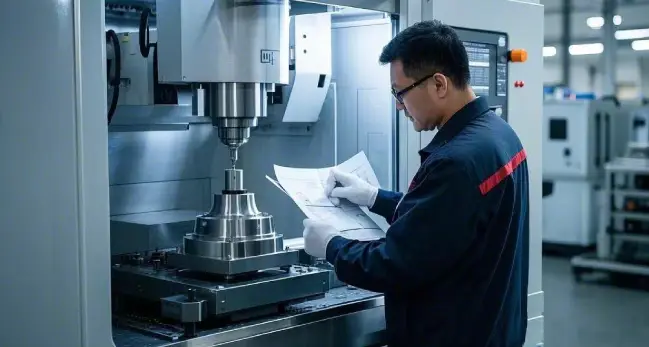
A typical workflow starts with CAD and drawing review. The manufacturing team confirms material, tolerances, critical datums, threads, port standards, valve cavity details, surface treatment, quantity, and documentation requirements. Material is then cut and fixtured for machining on multiple faces.
CNC milling produces profiles, mounting features, pockets, and sealing faces. Drilling and boring create passages and precision holes; threading completes fitting interfaces. Deburring and cleaning are critical steps, especially at port entrances and accessible internal intersections. Finishing may include anodizing, zinc plating, nickel plating, passivation, or another customer-specified treatment.
Inspection Considerations
Inspection plans should match the application. Customers may request first-article inspection, material certificates, dimensional reports, thread-gauge verification, surface-finish confirmation, traceability, or a defined pressure-test method. For critical designs, confirming key port locations and valve cavities during prototype review can reduce risk before repeat production.
Partner With Vertex for Custom Hydraulic Components
Vertex Precision Technology supports custom CNC machining for complex industrial components, including hydraulic manifolds, valve blocks, adapter plates, and related fluid-power parts. Our CNC milling, CNC turning, multi-axis machining, EDM, and finishing capabilities help customers move from CAD models to production-ready components.
Send your 3D model, 2D drawing, material requirement, port specification, quantity, and target delivery date for a manufacturability review and quotation. From prototypes to repeat batches, Vertex can machine hydraulic components to your specifications.